


Calming Tools for Kids (and YOU!)

Are you feeling mindful or is your mind full? We live in a busy world! On the outside, there is so much going on around us that can capture all of our attention. On the inside, our feelings and emotions can change in an instant, and we can get lost in stories that keep replaying in our minds and pull on our hearts. Throughout the day, whether we are kids or adults, we are bombarded with thoughts, distractions and interruptions. The key is to be able to navigate the chaos and find calm in the present moment. This can begin with a simple smile and positive self-talk.

Think well to be well!
SMILE and the world
will smile with you!
Smile and say THANK YOU!
A smile is a road to peace- one that kids can learn early, and something that can change the world!
Live mindfully, Be kind to others, Live in gratitude!
The Power of the Breath
We breathe naturally every day! But there is even greater power in the breath when we intentionally take time to pause, be still, breathe in deeply, and breathe out slowly. Teaching children breathwork, and also learning and practicing as adults, helps us to manage our emotions, reduces stress and anxiety and allows the nervous system to calm. When we take time to breathe and allow stillness in our body, mind and heart, we feel better!
Here are some easy and fun ways to incorporate breathwork with kids, anytime throughout the day! We all need a moment to pause, breathe and feel regulated. This is a simple way to find stillness, take in 3 breaths together, and begin the day regulated, calm and ready for learning, growing and connections to take place! EVERYONE can benefit from calming tools! Try these suggested kid-friendly favorite breaths, but also be creative and make up your own breaths to find calm!
Balloon Belly Breath- Pretend that your belly is like a balloon. As you take in a slow, strong breath, notice how the balloon gets bigger as it inflates with air. Then as you slowly breathe out, pay attention to how the balloon gets smaller as it deflates. Take a few quiet moments to practice slowly inflating and deflating your balloon belly!
Flower Breath-Put your pinky fingers together and your thumbs together. Wiggle your other fingers, those are your flower petals! Close all of your fingers together. As you breathe in, open your flower petals, imagining the sweet smell of nectar. As you breathe out, close the flower petals. Try this a few more times.
Bubble Breath- Pretend you are holding a bubble wand in your hand. Taking a deep breath in, hold it for a moment before you slowly breathe out, visualizing shimmery bubbles floating in the sky. If there is something you are worried about right now, imagine that the bubbles are carrying that worry away.
Bunny Sniff- Sitting up tall and still like a bunny, breathing in through your nose, take three quick short sniffs in a row. Pause for a moment before slowly breathing out through your mouth. You can try making bunny ears or bunny paws with your hands, too! Do the bunny sniff several times, paying attention to the energy in your body as you breathe this way.
Hot Cocoa Breath- Pretend you are holding a mug of hot cocoa, the mug cradled between both of your hands. Bringing the mug near your face, take a slow breath in. Imagine that you are smelling the yummy, comforting chocolate aroma. Now, slowly, with gentleness, exhale, as you pretend to blow the steaming hot cocoa to cool it down. Maybe even imagine blowing a shape, like a heart, into your hot cocoa!
Rocks and Socks- Take in a deep, strong breath, and then make fists with your hands. Direct all of your energy into squeezing your hands with so much force, it is as if your strength can transform your fists into solid, indestructible rocks. When you can’t stand it any longer, exhale as you release your fists, letting go of all that tension, as if your hands and arms have turned into floppy, dangling socks. Try turning other parts of your body, such as your shoulders, legs, and feet, into rocks and socks, too!
Roller Coaster- Slowly trace your left hand with your right index finger, starting at the base of your thumb. As you trace each finger, breathe in as your finger climbs up and breathe out as your finger slides down. Pretend that your finger is a roller coaster car, going up and down the tracks….only instead of going fast, your roller coaster car moves very, very slowly. Once you have traced your entire hand, try it again, switching hands.
This breath can also be called 5 finger breath or starfish breath.
Hand Over Heart- Gently place one hand over your heart and your other hand over your belly. Zoom your attention on your breathing and to the sensations in the space between your two hands. After a few moments, move your hand from your belly to your forehead, still focusing on your breath, and space between your hands. Now place both hands over your heart, and tell yourself something kind and compassionate that you need to hear or try these suggestions: I am light!, I am wise!, I am truth!, I am loved!, I am strong!, I am creative!, I am safe!, or Everything will be okay!
Make up your own breath- Kids are so creative and come up with the best breaths on their own. Be open minded and playful! You can breathe together at home, in the car, at the grocery store, before bed. Anytime, anyone, anywhere!

Benefits of Mindfulness Practices
Calming tools are a great way to help children (and adults) build self-awareness, regulate their emotions, and feel centered and relaxed. Breathwork is an easy place to start because it is always with us to use anytime throughout the day! Other mindful calming tools include music and movement, yoga, drawing, journaling, or a walk in nature and fresh air. Try them all and see what works best for you!
There are many benefits to including calming tools in your day including:
Improves self-control and self-regulation skills
Helps to manage sensory overload
Strengthens resiliency and decision making
Engages enthusiasm for learning
Increases focus and concentration
Boosts immunity and promotes better sleep
Develops positive social skills empathy, compassion, patience, generosity, integrity, acceptance
Reduces peer-to-peer conflict
Promotes peace, happiness, joy and optimism
How do you feel when you are dysregulated?
How do you react when something doesn’t go the way you had planned or the way you expected it to go? Sit with that for a second….stop and think about a moment when you didn’t respond in a way that was compassionate to yourself or those around you. Notice what comes up. Were you LOUD or really quiet, maybe silent? What did you notice in your body? Was your heart racing, palms sweaty, or brain feeling over-loaded? We can come back to the story immediately in our minds, and sometimes even relive the same thoughts and feelings as if we are right back in that space. Becoming self-aware allows us to pause in the moment, count to ten or take 3 deep slow breaths, to notice what is happening in our bodies and return to a state of calm, with grace.
Learning to breathe is important for kids because it gives them the skills to regulate their emotions, such as anger or fear, and to calm down during meltdowns or other stressful situations. The Zones of Regulation model is a great resource and visual to help kids decide their zone in the present moment. Try it for yourself! It is important to know that throughout the day, you will visit many zones as your emotions fluctuate! When you are not in the green zone, you are dysregulated. Self-awareness is noticing your emotions, thoughts, and behavior and becoming aware of how you react, your stress response. Are you able to handle challenging situations with ease or do you begin to feel stressed-out?

Mindfulness and the Brain
Our brain and body work together to help us to be more self-aware and to be able to regulate our emotions so we can feel back to ourselves again! Teaching children how their brains work and how our bodies react empowers kids to manage “big” emotions, understand why they feel certain ways and develop habits of using their calming tools to influence their stress responses-their thoughts, feelings and actions. Teaching children about how their brain and body work together isn’t as hard as it seems…make it fun and relatable by putting it in kid-friendly terms.

SURVIVAL STATE-Hippocampus- “The Save Button” or “Librarian”
Located deep in the brain, behind your ears-temporal lobe
Developed by age 18-25
Stores, organizes and recalls memories
Helps us to learn new things and takes short-term thoughts and saves them as long-term memories
When the amygdala is upset, the hippocampus can’t store memories or properly bring them to mind
Focus: Connection
Behaviors: argues,refuses, distracts, pushes limits, clingy
EMOTIONAL STATE-Pre-frontal Cortext- “The Wise Owl”
Located right behind the forehead
Developed in the mid-20’s
Figures out answers to problems
Helps us to pause, think and breathe so that we can make good, well balanced choices
Helps us to control our impulses, manage big emotions, pay attention and plan ahead
Sends and retrieves memories to and from the hippocampus
When the amygdala is upset, the pre-frontal cortex can’t help us
Focus: Safety
Behaviors: Fight- hits, kicks, yells
Flight-runs, leaves room, hides
Freeze-shuts down
EXECUTIVE STATE-Amygdala-”The Jumpy SuperHero”
Located deep within the temporal lobes, in both cerebral hemispheres
Developed by age 25-30, matures through adolescence with growth and connections occurring in mid 20’s
Tries to protect us at all costs, but often mistakes stress with real threats and stops the pre-frontal cortex from getting the information it needs to help us make good choices
When the amygdala is calm, it gives the pre-frontal cortex what it needs
Focus: Learning
Behaviors: completes work, focused, follows directions,
problem-solving and planning
Mindfulness to the Rescue
Mindful calming tools work!!!
The amygdala is calm and allows information to flow to the pre-frontal cortex-the part of our brain that helps us make good choices
When we are calm, we can more easily be mindful, make good choices, be kind, and find gratitude and JOY! Take time to slow down, notice all of the beauty that surrounds you. Find appreciation for it all, the times that bring tears of sorrow and those that bring smiles of joy. Begin to recognize patterns in your own behavior responses and be intentional about stopping to breathe in the moment. No appointment necessary. No excuses for not having enough time. It takes a minute…a mindful moment, to move from a chaotic mind and tense body to a calm mind, relaxed body and joyful heart that can enjoy the moment…one breath at a time!
Be a model of self-care and take time for YOU!
Start a journal-Tell yourself daily that you are enough!
Be aware of your self-talk-Is it positive or negative?
Practice mindfulness-sitting still quietly and focus on the breath
DO YOGA!-It makes you feel good inside and out..on and off the mat!
Practice random acts of kindness-spread joy!
Connect to who you truly are- because you are worth it and there is no one else like you!
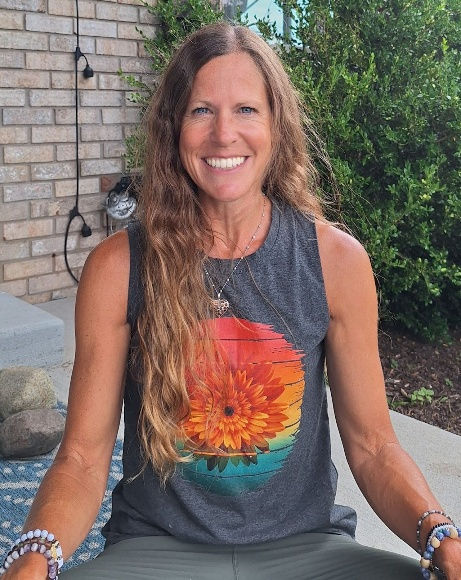
Mitzi Johnson, MEd, 200 RYT, Mindfulness and Meditation Teacher, Advanced Practitioner in Mind-Body Medicine, has a passion for teaching yoga and mindfulness to everyone, everywhere! She is an elementary school teacher and began her yoga journey in her classroom! She uses breathwork, guided meditation, loving-kindness phrases, music and movement, and journaling to provide a safe space for kids to regulate their emotions and feel a sense of calm in their minds, bodies and hearts. While teaching children the tools of mindfulness, she was receiving the same benefits of self-care. This ignited a passion to learn more, practice more, and share more!
She became a yoga teacher in 2019 and received certifications in Kid's yoga, Restorative yoga and Yin yoga in 2022. While attending a 10-day silent retreat at Spirit Rock Meditation Center in California, she experienced the gift of true inner peace. This led to a two year study of meditation with the focus on awareness and compassion practices. She received her Mindfulness and Meditation teacher certification in 2025 and has learned how to pause and appreciate time to relax, restore, and rejuvenate. In late 2025, she began studying self-care skills through The Center of Mind-Body Medicine and became an Advanced Practitioner. She is a lifelong learner and values a life balanced by tasks and lists of things to accomplish with completely unplugging, appreciating nature and being in stillness. Mitzi’s yoga classes are inspired by affirmations, heartfelt experiences, and curiosity. Her desire for herself, and for others, is to continue to learn, grow and meet life’s challenges with ease and joy!


Comments